The Four-Tier System for Deep Focus: How to Structure Your Time Once Your Projects Are Sorted
Sorting your projects brings clarity. Structuring your time brings progress. In Part 2, I share the Four-Tier System that helped me protect deep work, batch by brain mode, and stop choosing coffee over tea when it mattered most.

Part 2 of 2 - Read Part 1
The Night I Chose Coffee
Last week, this article didn't happen.
It was supposed to. I had the outline and the evening planned on Thursday night, which is my writing night. Warm tea. sunlight lamp. The setup that tells my brain, "You're a writer."
Then a customer call came in on Tuesday, reshuffling everything, urgently. The urgent where saying "I'll get to it next week" isn't an option if you care about the work and business relationship. So, Tuesday bled into Wednesday. Wednesday ate Thursday. And by Thursday night, I was staring at two open windows. the customer solution I still needed to finish, and the blank page where Part 2 was supposed to exist.
I made my herbal tea anyway, a force of habit.
And again, I looked at the screen, looked at the tea, and that's when I swapped it for coffee.
That was the clue. I wasn't writing tonight. My brain had already chosen. The coffee made its case and won.
The night ended fine. I shipped the customer fix. Tap on the shoulder, and another customer is content. But I logged off carrying that specific guilt creative people know too well, a kept promise to someone else is the price paid for a broken promise to yourself.
The Problem: Sorting your Projects Doesn't Solve
In Part 1, I talked about sorting your projects into three categories: Current, Future, and Archived. If you haven't read it, start there; what follows only works after the sorting is done.
But here's what I left out: sorting doesn't protect your time. It only clarifies your intentions. That's an important detail.
You can label your book a Current project and still never touch it for three weeks. You can know exactly which project matters most and still find yourself choosing coffee over tea because someone else's urgent became your emergency.
Categorizing and sorting them tells you what you should be focusing on, but it doesn't tell you when, how, or who you need to be while doing it.
That's what this system is for. It has five parts, and they work together:
- The Four Tiers: How to sub-prioritize your Current projects so not everything competes for the same energy.
- Brain Modes: Why you should batch by cognitive mode, not by task list.
- The Environment: How to use physical cues so your space does the switching for you.
- The Honest Check-In: A 10-minute weekly reset that keeps the system aligned with your actual life.
- The Small Closing Habit: One sentence at the end of every session that changes how you rest.
None of these is complicated, but stacked together, they turned my scattered evenings into something that helps achieve my work.
Not All Current Projects Are Equal
After I sorted my projects, I looked at my Current list - book, app, blog, Sumerian - and thought, "This makes things clearer, but how do I get this done?"
The sorting helped me release Future projects from guilt and let go of Archived ones. It clarified my true intentions. But my Current projects were still competing for the same evenings and the same energy. I risked touching everything and finishing nothing.
What I needed was a way to decide how much of myself each Current project actually gets. That's where the four tiers come in, a system that lives inside your Current category.
Your Future projects still exist on your list, guilt-free. Your Archived projects are resting. This is about the "let's get this done now" ones.
The Four Tiers
Tier 1: The Primary. One project gets deep focus for the x amount of period, for example, 6 months. "Which project, if it actually moved forward in the next six months, would most change how I feel about my life goals?" That's your Primary. Best hours, non-negotiable commitment. For me, it's the book, because that's the one I'll regret most if it's still "in progress" next year.
Tier 2: The Lighter Project. One other Current project stays active in your productivity eco-system. Plan light: 30 minutes, twice a week, with one small output per session. My Lighter project is the app, with a minimum of one commit each Monday and Wednesday night. The minimum signal that tells your brain: I'll be back (excuse the cliché).
Tier 3: The Rhythms. Practices you maintain no matter what. They don't compete with your Primary because they aren't trying to reach a finish line; they're maintenance for the person doing the work. Keep them small: 15-45 minutes daily, or one weekly block, max. The moment a Rhythm starts feeling like a project, scale it back. I have a few: my Sumerian reading and practice, 30 min weekday mornings. My weekly blog posts, Thursday evenings, and my favourite, Date night on Fridays.
Tier 4: The Rotation List. Everything else that's genuinely Current but not active at the moment. Write down why it matters and when its turn comes. For me, this is where my creation of YouTube videos lives, noted, valued, waiting after the book ships. The Rotation List isn't a graveyard. It's a waiting room with a clear queue.
Brain Modes
Batch by Brain Mode, Not by Task
This is the thing most productivity advice gets wrong, and it changed everything for me.
I first felt it in college, when I was bussing tables at a busy restaurant and studying pure and applied sciences. Saturday mornings, the moment I stepped into that restaurant, apron on, comfortable shoes laced, my brain flipped into service mode. No integrals, no antiderivatives. Just: is that lady's glass half empty? Sundays were different. As soon as I walked into the library, I could practically see Einstein at the chalkboard explaining relativity. My mind shifted to study mode before I even sat down.
I didn't have a name for it then, but it's the same thing I deal with now. Writing and coding are both "computer work." Same chair, same screen. But they need completely different versions of you. Writing asks for emotional openness, vulnerability, rhythm, and a loose grip.
Coding demands logical precision, sequential thinking, and pattern recognition. Coding rewards the part of your brain that spots errors. Writing needs that part to shut up.
Put both in the same evening, and they fight each other. Your editor brain won't let your creative brain breathe, and your creative brain keeps wandering when you need to focus. That's not a discipline problem. That's a conflict of modes.
The reason is that creative writing and coding aren't just different tasks. They're different cognitive modes. And switching between them doesn't cost you a few minutes; it costs twenty or thirty minutes of muddled half-thinking while your brain figures out which version of you it's supposed to be.
I used to block evenings as "project time" and try to write a chapter, fix a bug, and draft a blog post in the same sitting. I wasn't working on three things. I was working on nothing, three times.
The fix: assign each time block a mode, not a task list. When it's writing night, you're a writer. The terminal doesn't exist.
When it's coding night, you're a builder. The manuscript can wait. And if that means putting on an apron, then put one on!
My Actual Week
Don't copy the schedule, copy the logic. The specific days and duration matter less than why things land where they do.
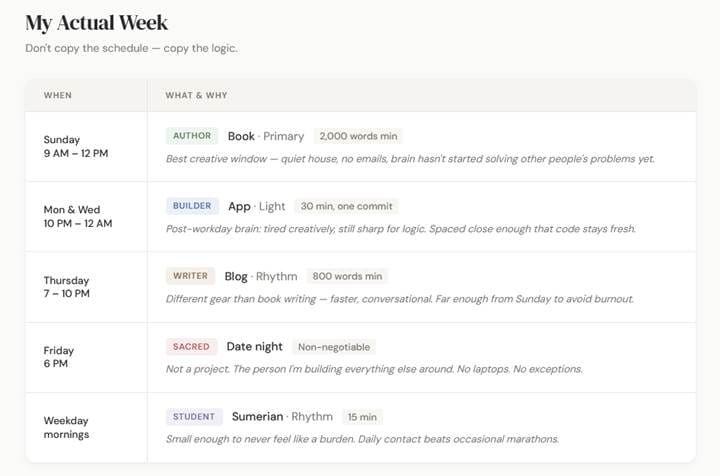
What's not on the schedule: the spy thriller (Future, check in when the mood strikes), YouTube (Rotation, most likely after the book), and everything else that is Archived. They don't need time blocks.
The Environment
Let the Room Decide
Willpower is a terrible switching mechanism. If you rely on discipline alone to shift from builder mode to writer mode, you'll burn through your reserves before writing a sentence.
So stop asking your brain to make the switch. Ask your environment instead. Stack cues, small signals - like a cup of herbal tea- that all say the same thing: this is who you are right now.
Physical space. Book writing on the couch. Coding at the desk. Never cross them.
Virtual desktop space. Separate browser profiles and desktops, one minimal for writing, one loaded for building. Being a tech nerd, i have a notebook for every occasion.
Lighting. Cool white for coding. Warm lamp for writing. Sounds insignificant, trust me, it helps. Try it for a week.
Music. Blade Runner (1982) soundtrack when I'm coding. Hans Zimmer's " When I'm Writing. Your ears set the mode faster than your brain does.
Beverages. Coffee for problem-solving. Tea for writing. The night I swapped tea for coffee, I wasn't choosing a drink; I was telling my nervous system which version of me was showing up.
If you stack enough cues, motivation becomes almost irrelevant. The environment pushes you there.
The Honest Check-In
The 10-Minute Weekly Reset
Every Sunday before going to bed, I ask these four questions. No app. No spreadsheet. Ten minutes.
1. Who am I, and what am I working on? Reminds me what the Primary is and why it matters. Some weeks, I need this more than others.
2. What are my 3–5 next actions for the Primary? Not goals, actions. "Write the chapter on what is consciousness." "Rework the opening anecdote." Specific enough that my primary starts with momentum, not figuring out where I left off.
3. Did I hit my minimums for the Lighter projects? Yes or no. If no twice in a row, that's a pattern worth noticing, not judging, just noticing.
4. What's nagging me? This catches everything else. A Future project pulling at my attention. A Rhythm I've been skipping. A project that needs to shift categories. This question keeps the whole system honest.
Important: I don't wait until Sunday to deal with stray thoughts. When an idea, a forgotten task, or some random thought shows up uninvited - in bed, mid-conversation, in the shower, I write it down at the first available moment, label it, and move on. I never let a non-primary thought live rent-free in my mind. The weekly reset handles the big picture. This handles everything in between.
The Small Closing Habit
The Shutdown Ritual
I used to close my laptop, carrying three projects' worth of loose threads into my evening. Now I carry one sentence. The difference in how I sleep alone made the whole system worth building.
A simple habit in my system, and for me, the most important.
At the end of every work session, one sentence:
"Next time, I will _____."
That's it. "Next time, I will start Chapter 7 with the conversation about fear." "Next time, I will fix the auth bug on the settings page."
When you stop without closure, your brain keeps circling, at dinner, in bed at 1 AM. That one sentence gives you permission to let it go. It knows where to pick up, so it stops looping. It puts the dot at the end of the sentence.
The Real Tragedy, Revisited
It won't help if you haven't sorted your projects. Tiers only work on Current projects, and Current only means something if you've separated it from Future and Archived. Go back to Part 1.
It won't help if your timelines are fantasies. A book takes a year. An app takes months or years. The best system in the world can't fix a deadline that was never real.
It won't help if you genuinely don't have the time. If you're underwater with work, family, and health, you might need zero Primary and zero Light projects right now. Just Rhythms and relationships. That's not failure. That's knowing what this season requires.
And it won't prevent the Thursday night problem. Life will rearrange your plans without asking. What the system does is hold your place, so you know exactly where to return when the disruption passes.
The real tragedy isn't having ambition. It's carrying it around for years without ever building the structure that lets it move. Clarity without structure is just self-awareness with no engine.
One project gets your full self. One stays alive at a minimum. Your Rhythms keep you grounded. Everything else waits. And when life shoves you sideways (because it will), the system holds your place.
That Sunday after my loss of Thursday, I sat down. Made tea. Read my shutdown sentence: "Next time, write Part 2 — start with the night you chose coffee."
So I did.
Sort your projects. Structure your time. Protect your tea nights.
Then build.
Ed Nite.